Why Is AI Creating More Work for My Team?
September 2, 2026
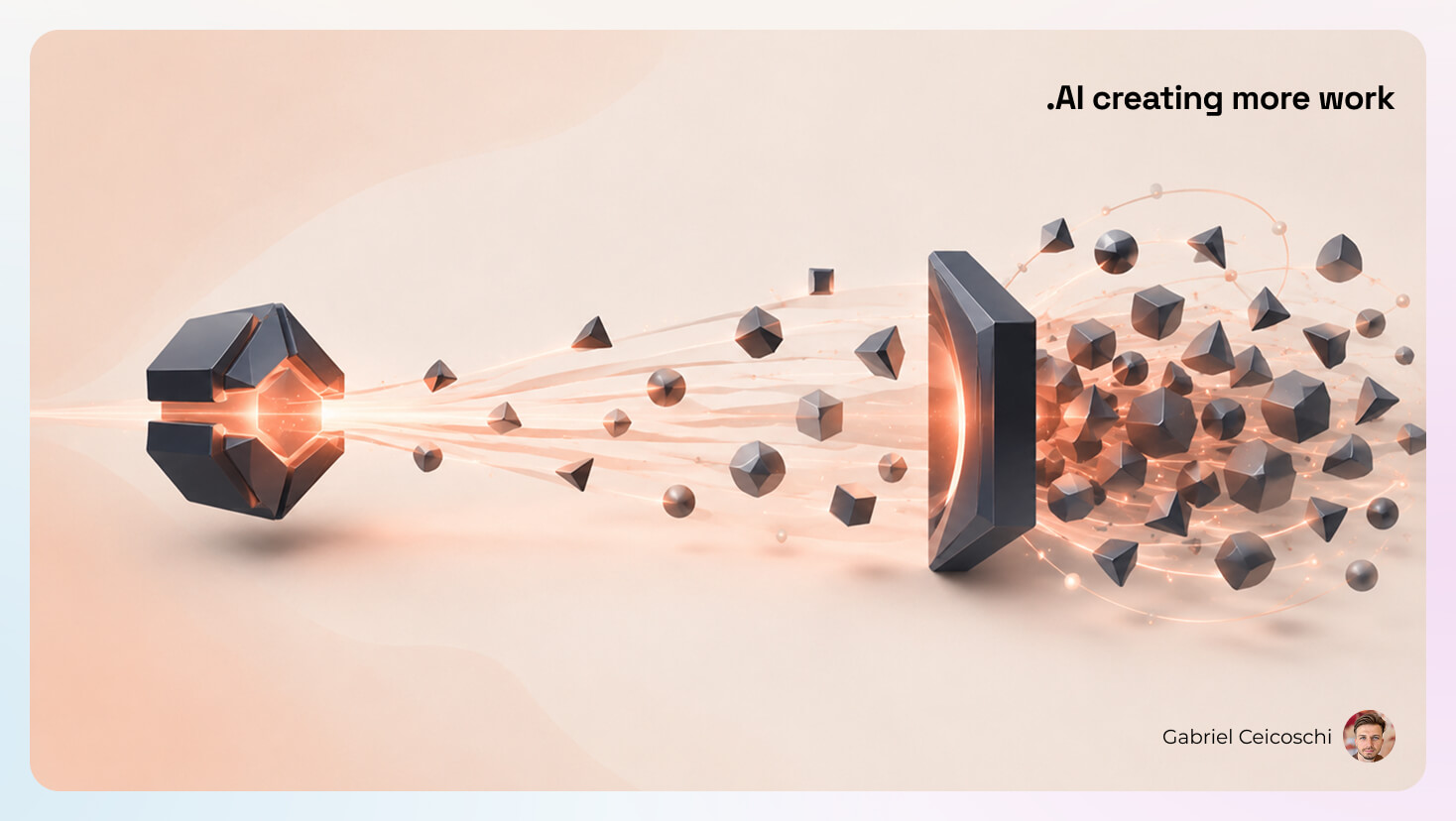
AI was supposed to save your team time, so it can be confusing when the opposite seems to happen.
People are producing more reports, more analysis, more drafts, more ideas, more code, and more presentations. Managers have more material to review. Specialists are pulled into more questions. Teams have more options to discuss and more decisions to make.
This does not necessarily mean the AI is failing. In many cases, it means AI is working exactly where it was introduced while the rest of the workflow has remained unchanged.
AI can increase the speed of production faster than an organization can increase its capacity to review, coordinate, prioritize, and decide. The work does not disappear. It moves.
What happens when AI makes one part of the workflow much faster
Imagine a simple process where an employee creates something, a manager reviews it, and the final output goes to a customer or another team.
Before AI, the employee might spend four hours preparing the work. After introducing AI, the same task takes one hour.
That sounds like a 75% productivity improvement, and locally it is. But the employee can now produce several pieces of work in the time it previously took to produce one. If the manager still needs to review everything, the review queue grows.
The organization automated production without redesigning the rest of the process.
This pattern is easy to miss because most productivity conversations focus on the person using the AI. The employee sees a dramatic improvement. The manager downstream experiences additional work. Both observations can be true at the same time.
Where does the bottleneck move after AI speeds up the work
BCG's 2026 AI at Work research gives us a useful picture. A large share of regular AI users report substantial time savings, yet many workers also say they are spending more time directing AI, reviewing or correcting its output, and making decisions.[1]
That apparent contradiction makes sense once you look at the entire workflow.
AI can make research faster while increasing the amount of research a manager needs to evaluate. It can make drafting faster while increasing the volume of drafts entering review. It can help employees generate more options while leaving the decision-maker with more options to compare.
The productivity gain is real, but so is the new downstream workload. The more useful question is not whether AI saved time somewhere in the process. It is what became the new constraint after that time was saved.
What happens when AI lets people attempt work outside their role
There is another reason AI can create more work. It lowers the cost of doing work outside someone's traditional specialization.
A salesperson can prepare a detailed market analysis. A marketer can analyze customer data. An operations employee can build a financial model. A finance employee can prototype a small internal tool. A non-technical manager can create something that looks surprisingly close to a product specification or strategic analysis.
This is one of the most powerful effects of AI. People can become capable of attempting work that previously required much more time, technical knowledge, or support from another department.
Producing something and knowing whether it is good are different capabilities.
We have seen this repeatedly in our own work. AI can help someone cross surprisingly far into another discipline, but it does not automatically give them the experience required to judge the result. The number of people who can produce the work can increase faster than the number of people who can confidently validate it.
That is where a new kind of review bottleneck starts.
Why does expertise become more valuable as production gets cheaper
AI is reducing the cost of many forms of execution. A first draft can be created quickly. Research can be gathered and summarized. Data can be analyzed. Code can be generated. Documents can be structured. Variations can be produced almost instantly.
But expertise, judgment, accountability, prioritization, and trust remain relatively scarce.
PwC's 2026 Global AI Jobs Barometer reflects this shift. Skills are changing especially quickly in jobs exposed to AI, while capabilities such as judgment, creativity, leadership, and strategic thinking are becoming more important. The most AI-exposed junior roles were also far more likely to demand skills that traditionally appeared later in a career.[2]
The economics of knowledge work are changing. When execution becomes cheap, knowing what deserves to be executed becomes more valuable. When producing ten options becomes easy, selecting the right one becomes the expensive part.
One principle we keep coming back to is that AI can multiply mediocre output just as easily as good output. Faster production only helps if the workflow has a reliable way to decide what is correct, useful, or worth escalating.
Should humans review everything AI produces
One natural response to AI uncertainty is to add human review.
AI drafts something, so a person checks it. AI analyzes something, so an expert verifies it. AI completes part of a process, so a manager approves the result.
That is sensible when the consequences of being wrong are high. It becomes a problem when every AI-assisted action receives the same level of scrutiny regardless of risk.
If a senior employee has to inspect every AI-generated output line by line, the organization has not created a scalable workflow. It has created an extremely productive junior worker and assigned a human supervisor to monitor everything it does.
The better question is which outputs genuinely require expert attention.
Some work is easy to verify. A document either contains every required field or it does not. A calculation either matches the underlying data or it does not. Generated code either passes its tests or it does not. A request can often be checked against a defined policy. Extracted information can be compared with its source.
Other questions are fundamentally different. Is this the right strategy? Is this the correct interpretation of an ambiguous situation? Should we enter this market? Is this the appropriate recommendation for this customer? Those decisions depend much more heavily on context, experience, accountability, and judgment.
The useful dividing line is not simply AI versus human. It is what the system can verify reliably and where human expertise materially improves the outcome.
How do you build verification into an AI workflow
This changes how AI implementation should be designed.
An old workflow might look like this: information comes in, an employee performs the work, a manager reviews it, somebody approves it, and the output goes out.
A redesigned workflow might allow AI to process the information first, run automated checks, and send only unusual cases to an employee. In another process, AI might prepare the research, a human makes the consequential decision, AI executes the decision, and automated verification confirms that execution followed the rules.
In technical workshops, we have found it more useful to classify AI actions into three levels than to talk vaguely about keeping a human in the loop. Some actions can be read-only. Some can produce drafts for review. Others can execute changes only after an approval gate. The level of oversight should match the consequence of the action.
That simple distinction forces teams to think more precisely about risk. It also stops them from adding the same human review step to everything AI touches.
Deloitte's 2026 enterprise research points in a similar direction. More advanced organizations are not just deploying models. They are redesigning processes, governance, and operating structures around how AI actually participates in the work.[3]
The point is not to maximize autonomy. The point is to place human attention where it creates the most value.
When should an expert actually review AI output
Experts are scarce and expensive because their judgment matters. Their time should be concentrated on the situations where that judgment changes the result.
If every output eventually reaches the same specialist, the company has created a fragile system. Everyone can produce, but only one or two people can approve.
A better workflow distinguishes between routine cases and exceptional ones. Low-risk work with objective checks can move automatically. Work with known criteria can be processed by AI and handled by the employee. Unusual, high-risk, or consequential cases can be escalated to the expert.
This changes the purpose of review. The expert no longer acts as universal quality control. Their attention is reserved for the cases where expertise is actually necessary.
Can coordination become the next AI bottleneck
Review is not the only constraint that can grow after AI adoption.
Cheaper production also creates more projects, more options, more ideas, more documents, more conversations, and more opportunities to coordinate across teams.
AI lowers the cost of generating an idea. It does not reduce the cost of aligning five people around that idea by the same amount.
This is one reason companies can feel simultaneously more productive and more overwhelmed. Individual employees are capable of doing more, but the organization's coordination mechanisms still operate at roughly human speed.
A team might be able to generate five campaign concepts instead of two, but leadership still needs to choose one. A product team can explore many more ideas, but engineering capacity is still limited. A strategy group can generate dozens of scenarios, but the company can only execute a few.
At some point, producing more becomes less important than deciding what deserves attention.
What should managers look for when AI creates more work
If AI appears to be creating more work, the first step is to identify where the workload is accumulating.
Look at what became easier to produce and then follow the work downstream. Who receives the additional output? Why does it require their attention? Is the review necessary because the work is genuinely risky, or because the workflow inherited an approval step from the old process? Could some of the verification happen automatically before the work reaches a person?
These questions help reveal whether the organization is experiencing an AI problem or simply a workflow that has not adapted to a new level of production capacity.
The goal is not to produce as much AI-generated work as possible. The goal is to move more useful work toward the right outcome with less unnecessary effort.
How does the manager's role change with AI
This shift also changes management.
Managers may spend less time checking the mechanical execution of every piece of work and more time designing the system around that work. They need to decide where AI operates, what employees own, what can be checked automatically, what becomes an exception, and which decisions still require human accountability.
These are operating-model decisions, not prompting decisions.
Once one part of a process becomes dramatically faster, the manager's job is to look at what became the next bottleneck. It might be review, approval, expertise, coordination, implementation capacity, or decision-making.
Then the workflow needs to be redesigned around the new constraint.
What happens if you optimize only the step AI accelerated
A stronger AI model can make one task five times faster without making the system around it five times better. If everything downstream remains unchanged, the productivity gain can simply create a larger queue somewhere else.
The objective is not to create more AI-generated work. It is to create a better system for getting work to an outcome.
If your experts spend their days cleaning up everything AI allows everyone else to produce, the technology did not remove your bottleneck. It moved it.
If AI is making your team faster but also creating more review, coordination, or decision work, the workflow probably needs redesigning around the new bottleneck.
Frequently Asked Questions
Why is AI creating more work instead of saving time?
AI often makes production faster while downstream activities such as review, approval, coordination, and decision-making remain unchanged. One part of the workflow becomes more productive while another receives more work.
Why does AI create a review bottleneck?
More employees can produce sophisticated work more quickly, but the number of people with enough expertise to validate consequential outputs may remain the same. Review capacity therefore grows more slowly than production capacity.
Should humans review all AI-generated work?
No. The appropriate level of review depends on risk, consequence, and how easily the result can be verified. Low-risk work with reliable automated checks may require little manual review, while ambiguous or consequential decisions should retain human judgment.
How can companies reduce AI review work?
Build verification into the workflow, define escalation rules, automate objective checks, classify work by risk, and send experts only the cases where their judgment genuinely matters.
Does AI make managers less important?
Not necessarily. It may shift the manager's role away from checking execution and toward designing workflows, defining decision rights, managing exceptions, allocating attention, and deciding where human accountability belongs.
Related articles
Show us how your team works.
Bring a process that wastes time or money. We will help you build an AI workflow around your data, tools and limitations.