What does it take to build an AI system on your own sales data?
November 4, 2026

For the past months we've been building an AI system on top of the ERP data of a manufacturer that sells through distributors. Their sales team knew their clients. We knew how to build the system. Most of the work was in between: agreeing what to build, making the data safe to use, and getting people to trust it.
This is a breakdown of how we did it, what the industry says about projects like this, and what we got wrong. If you're building something similar, you will find this useful.
Why are so many of these projects failing?
Gartner expects over 40% of agentic AI projects to be canceled by the end of 2027. At the same time, interest in sales is high. In McKinsey's B2B survey, 19% of companies were already implementing gen AI use cases in sales and another 23% were in the process. Their examples include an industrial distributor that used AI on its own sales data to find new opportunities and grow its pipeline.
The big vendors are building in the same direction. ERP and CRM platforms now ship their own assistants. So the question for most companies isn't whether AI can read their sales data. It's whether they can build something their own people trust, on data they're allowed to use, that their IT team can keep running.
BCG puts it in one line: their AI work follows a 10-20-70 approach, 10% algorithms, 20% tech and data, 70% people and processes. That matches what we saw. The code was the smallest part.
How did the project start?
With a lot of conversations, long before any code.
We spent months with the IT manager working out what was worth building. Not what AI could do in general, but what their team actually needed, what the data could support, and what the manager could approve.
Those conversations covered three things:
- The data. What sits in the ERP, how clean it is, who knows what it means, and what we were allowed to touch.
- The expected results. What a good answer looks like for a sales manager, and what would make the team use it on a normal Monday.
- The priorities. Which questions cost the team the most time today, and which ones they could act on.
We started with a long list of ideas and cut it down to seven or eight outputs. That was the most useful decision in the whole project. Each output answered one business question:
- Which clients bring in most of the sales, by period, market or product
- Which clients are likely to go quiet, and why
- Which clients pay outside the agreed terms, and what turns late next
- Who buys the most of each product
- Where bonuses and discounts go, and whether they pay off
- Whether growth comes from more volume or from higher prices
- What happens if we lose a client or drop a product
- Unusual behaviour worth a look, like a spike, a drop or a data error
Then we split them into phases. Each phase had clear deliverables and its own testing period, so the team could check one thing before we started the next.
Two things took longer than we planned. The first was testing. We assumed people would test a phase in a week or two. In practice, it took much longer, because they were doing their normal jobs at the same time and learning a new way of working. The second was the mindset. People who have done the job well for years don't need a new tool. They need a reason to trust it.
What did the sales team actually need?
Answers to their own questions, without waiting on IT.
The team had years of ERP data, some dashboards and a lot of manual extracts. Every new question meant asking someone technical for another report, so people stopped asking follow-up questions.
They knew their clients far better than we did. Our job was to make sure the system could follow their line of thinking, from a broad question down to a call list:
- Sales of a product by market
- Month by month, against last year
- Which clients drove last month
- Which clients are buying less
- Which products those clients stopped buying
- A list of who to call
That chain used to take days of extracts. Now it takes a few minutes, and each answer leads to the next question.
How is the system built?
In four layers. Each one does one job, and that's what makes the answers trustworthy.
| Layer | What it does | Who looks after it |
|---|---|---|
| Data layer | Copies sales, customer, product, invoice, payment and bonus data from the ERP into the client's own environment every night, and checks it | IT |
| Insights layer | Runs approved analyses and prediction models, and prepares common reports in advance | IT with sales and finance |
| Agent layer | Picks the right analysis for a question and explains the result | IT |
| Application layer | The chat, dashboards and alerts people use, with access based on their role | Used by sales and finance, improved by IT |
Why doesn't the AI calculate the numbers?
Because a language model is good at explaining and bad at being an accountant.
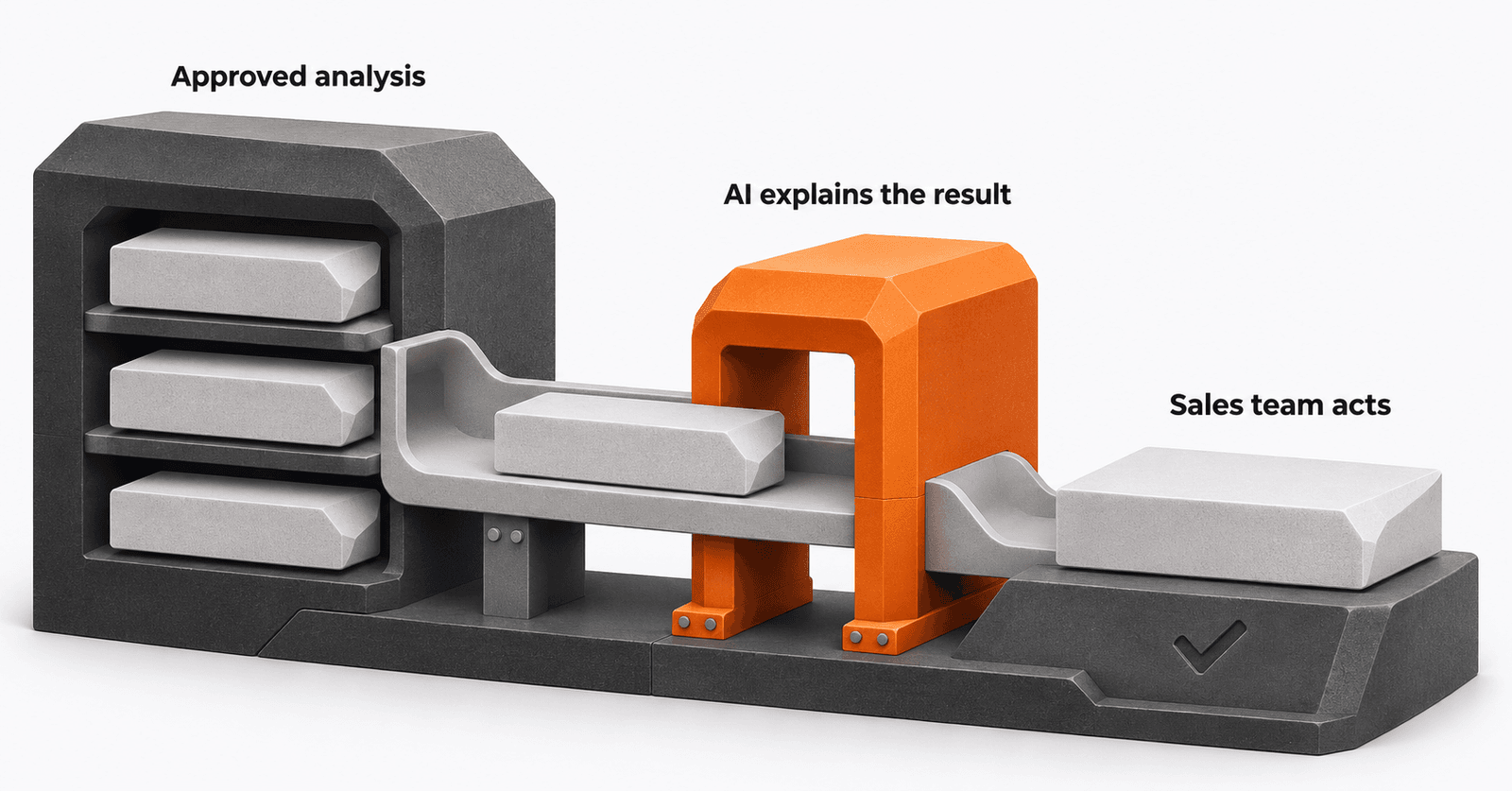
The rule we followed: the model is the narrator, not the vault. The numbers come from approved analyses and statistical models in the insights layer. Each one answers one business question in a fixed, tested way. The agent picks which one to run, and explains the result in plain language. When a question falls outside what it can answer reliably, it says so instead of guessing.
The dashboards and the agent read from the same curated layer. So the chat and the dashboard can never disagree on a number, and finance can check any answer against the ERP.
Why shouldn't the agent query the raw data?
Our first version let it. It pulled years of data for one question and crashed the application.
Even when it doesn't crash, too much data floods the model's working memory, its context window. It loses track and gives weak answers, and every question gets expensive.
The fix was to prepare the common reports in advance and let the agent drill down only when a question needs it: one period, one region, one product. It starts small and asks for more. That's cheaper, faster, and much easier to control.
What makes the data layer trustworthy?
Boring checks. The ERP is only read, nothing in it changes. Totals in the copy must match the ERP, and every answer shows how fresh the data is. If the numbers don't match what finance sees, nobody will trust anything built on top.
How do you make company data safe for AI?
This took more time than any feature, and it should. Sales data is full of client names, contacts, prices and payment behaviour. Here's how we approached it, and what we'd recommend to anyone building something similar.
Keep the data in the client's environment
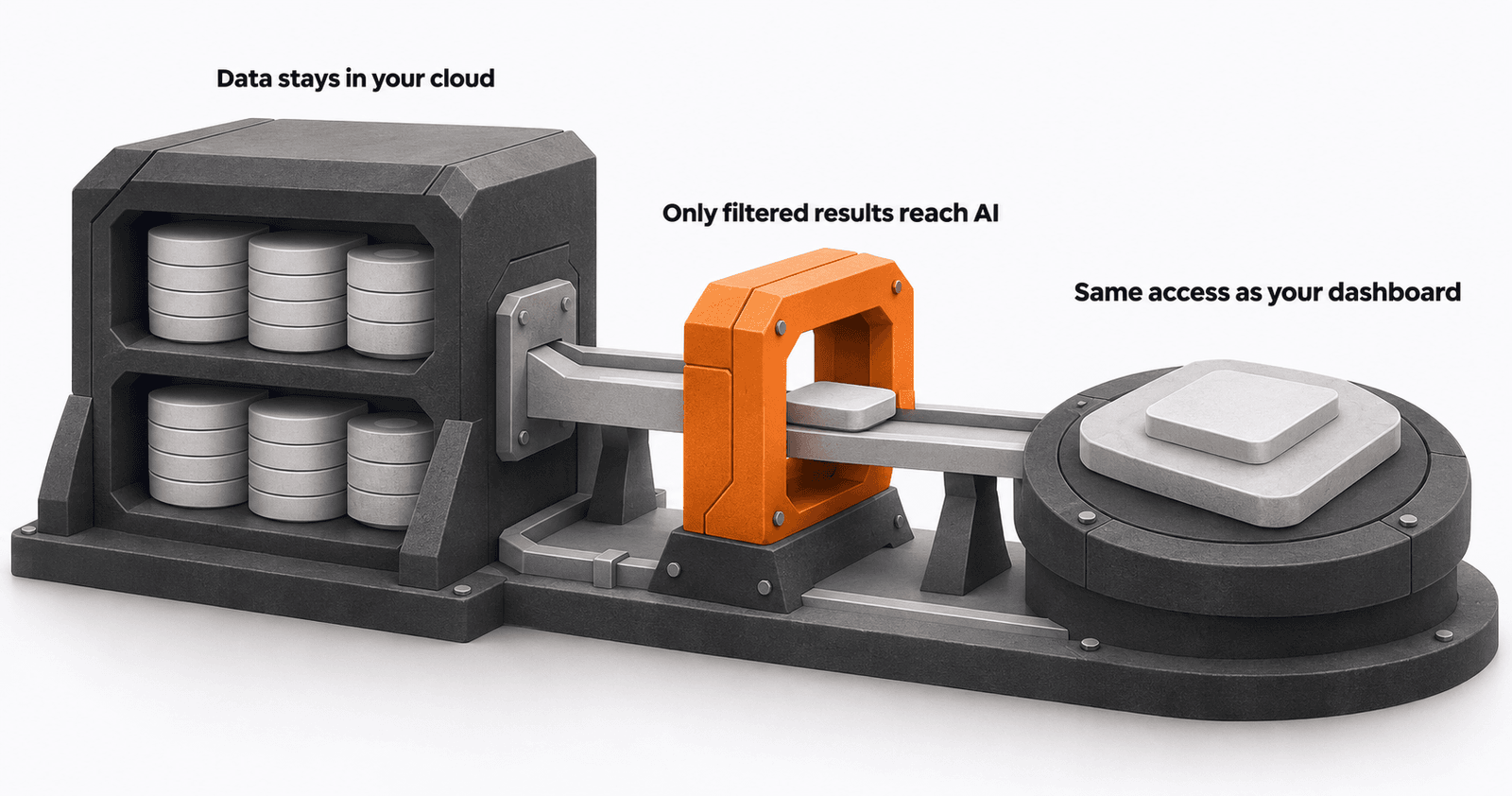
The data and the system run in the client's own cloud environment, not ours. They own the data, the code and the access rules. Their existing login, permissions and audit logs apply to the new system too, so IT doesn't have to trust a new place.
Give the AI as little as it needs
GDPR asks for data minimisation and purpose limitation: only use the personal data you need, for the purpose you stated. That fits AI systems well.
In practice:
- The model sees aggregated results from the insights layer, not the raw database
- Personal data is filtered or replaced with IDs before anything goes to an external model, and mapped back to names inside the client's environment
- Contact details and fields nobody asked for never leave the data layer
That last point mattered more than we expected. People wanted to search by client name, but the data used client numbers. Making that work without sending names to the model took care.
Use models from a trusted provider, on enterprise terms
Not every AI model is acceptable for company data. We only used models available through enterprise agreements or the client's own cloud tenant, with:
- No training on the client's data
- No or minimal data retention
- Processing in the region the client requires
- A data processing agreement that the client's legal team can review
For companies with stricter rules, an open-weight model hosted in their own environment is another option. It costs more to run and maintain, but nothing leaves the building.
The agent gets the same access as the person asking
Each salesperson only sees their own region and clients. We made sure the agent inherits exactly the same permissions as the dashboard, from one mapping of users to regions. If you can't see a client in the dashboard, you can't ask the agent about it either.
Every question and every answer is logged. That helps with audits, and it's also the best source of feedback for improving the system.
Check the rules for your region and industry
GDPR is the baseline in Europe, but it's not the only rule. Some industries add their own requirements on data, record keeping or who can see what. Some companies have internal policies stricter than the law. We sat with the client's IT and management early to go through theirs.
The EU AI Act also matters here, even for internal tools. Its AI literacy obligation has applied since 2 February 2025: companies using AI systems should make sure their staff have a sufficient level of AI literacy. According to the same briefing, the European Commission said supervision and enforcement of these rules start on 2 August 2026. There is no fixed training format, but keeping records of the training you did is sensible.
That brings us to training.
Who needs training?
Two groups, with very different needs. This is where most of the "70% people and processes" lives.
| Sales team | IT team | |
|---|---|---|
| Their role | Use the system every day | Run and improve the system |
| What they learn | What to ask, how to read the answers, when not to trust them, how to give useful feedback | How the layers fit together, how to update agents and analyses, access and permissions, logging, security and compliance |
| What success looks like | They ask follow-up questions instead of waiting for reports | They ship improvements every week without us |
How did we train the sales team?
By testing with them, not presenting to them. We agreed which questions to test and what a good answer looks like. We explained what the system was built for and what it wasn't, because people test a new AI tool the way they use ChatGPT: they ask anything and expect an answer.
The message that helped most: the system doesn't replace their judgment. It removes the waiting. Their knowledge goes into the system, not out of the company.
How did we train the IT team?
By building it together. We worked in weekly sessions with their engineers, so they understood each part before it was handed over. They own the full codebase, with documentation and a playbook for new people.
That paid off. The team has now had over 1,500 conversations with the system, and the client's IT team takes feedback from sales and improves the agents, tools and data every week.
How do you keep managers, users and engineers aligned?
Each group asks a different question, and you need an answer for all three.
- Managers ask: is it worth it, is it safe, and who is responsible? They need clear deliverables per phase and a straight answer on security and compliance.
- The people in the team ask: will this help me, or replace me? They need to be involved early, see their own questions answered, and have time to test.
- The engineers ask: can we run this, and is it built in a way we accept? They need to be in the architecture decisions, not handed a finished system.
What worked for us was a fixed weekly session, deliverables written down per phase, and a separate conversation with IT and management about security in their terms. What didn't work was assuming that one group's approval meant the others were on board.
What did we get wrong?
Most of our mistakes had little to do with the AI model.
| Mistake | What it cost | What to do instead |
|---|---|---|
| Letting the agent pull too much data at once | Crashes, weak answers, high cost | Prepare reports in advance and let the agent drill down |
| Not agreeing how to test it | Frustration and noisy feedback | Agree test questions with the team before the first demo |
| Underestimating the mindset part | Early rejection by experienced people | Show it as support for their judgment, and involve them early |
| Not planning time to learn what the data means | Weeks of back and forth | Plan knowledge sessions with sales and IT from the start |
| Assuming things about the client's IT | Weeks of rework | Check where systems run, which models are allowed and how login works in the first week |
| No time for feedback between phases | Phases that couldn't be closed | Plan testing and adoption time into every phase |
The IT one hurt the most. We assumed where their systems ran, which AI models they could use and how login would work, even for a first test. All three were wrong. In a larger company you can't change a model or an access rule on the spot, and that conversation should be planned from day one.
What would we ask before the next build?
Scope
- Which seven or eight questions matter most, and who decides?
- What does a good answer look like for each one?
- How long does each phase need for testing, realistically?
Data and security
- Where do the systems run, and can a new setup reach them?
- Which AI models and providers are allowed, and in which region?
- Which personal data is in scope, and can the AI work without it?
- How do people log in, and who decides who sees what?
- Which industry or internal rules apply on top of GDPR?
People
- Who will test it, and on which questions?
- Who can explain what the data means, and when do we meet them?
- Who needs convincing, and what would convince them?
- Who in IT will own it after the build?
None of these questions are about the model. All of them decided how fast the project moved.
Are you building something similar?
Then I'd like to hear how you handled it. How did you scope it down? Where did you draw the line on what the model can see? How did you get the team to trust the first version?
You can read more about this project in how we built a sales assistant with a manufacturer's own team. If you're comparing partners for this kind of work, our guide on how to choose an AI partner covers what to ask.
At Aibl.to we help teams use AI and build on top of their own data and processes, with training for the people who use it and the people who run it. If you want to compare notes, or get a second opinion on a system you're planning, book a 30-minute call.
Frequently Asked Questions
Does our data leave our company?
In the setup we describe, the data and the system run in the client's own cloud environment. The ERP is only read. Only aggregated results go to the AI model, with personal data filtered or replaced by IDs first, and the model runs on enterprise terms with no training on the data.
How do you keep it GDPR compliant?
By giving the AI as little personal data as it needs, for a clear purpose, using model providers with a data processing agreement and processing in the required region, and logging every question and answer. Industry and internal rules come on top of that, so check them with IT and legal early.
Can the AI give wrong numbers?
It can if it calculates them itself, which is why it doesn't. Approved analyses calculate the figures and the AI explains them. When a question falls outside what the system can answer reliably, it says so instead of guessing.
Can everyone see all the data?
No. The agent inherits the same permissions as the dashboard. A salesperson who can only see their own region can only ask about their own region.
Who needs training?
Two groups. The sales team learns what to ask, how to read answers and how to give feedback. The IT team learns how to run, secure and improve the system. Under the EU AI Act, companies using AI should also make sure their staff have sufficient AI literacy.
How long does it take?
Longer than the build alone. Scoping with the business took months, and each phase needed its own testing period, which took longer than we planned. The biggest time drivers were data checks, business validation and security, not coding.
Who maintains it after the build?
The client's own IT team. They own the codebase, with documentation and a playbook, and improve it every week based on feedback from sales.
Related articles



Where would AI help your team?
Tell us about your team and the work you want to change. We'll help you pick the right next step.