How Do You Get Your Team to Actually Use AI?
September 6, 2026
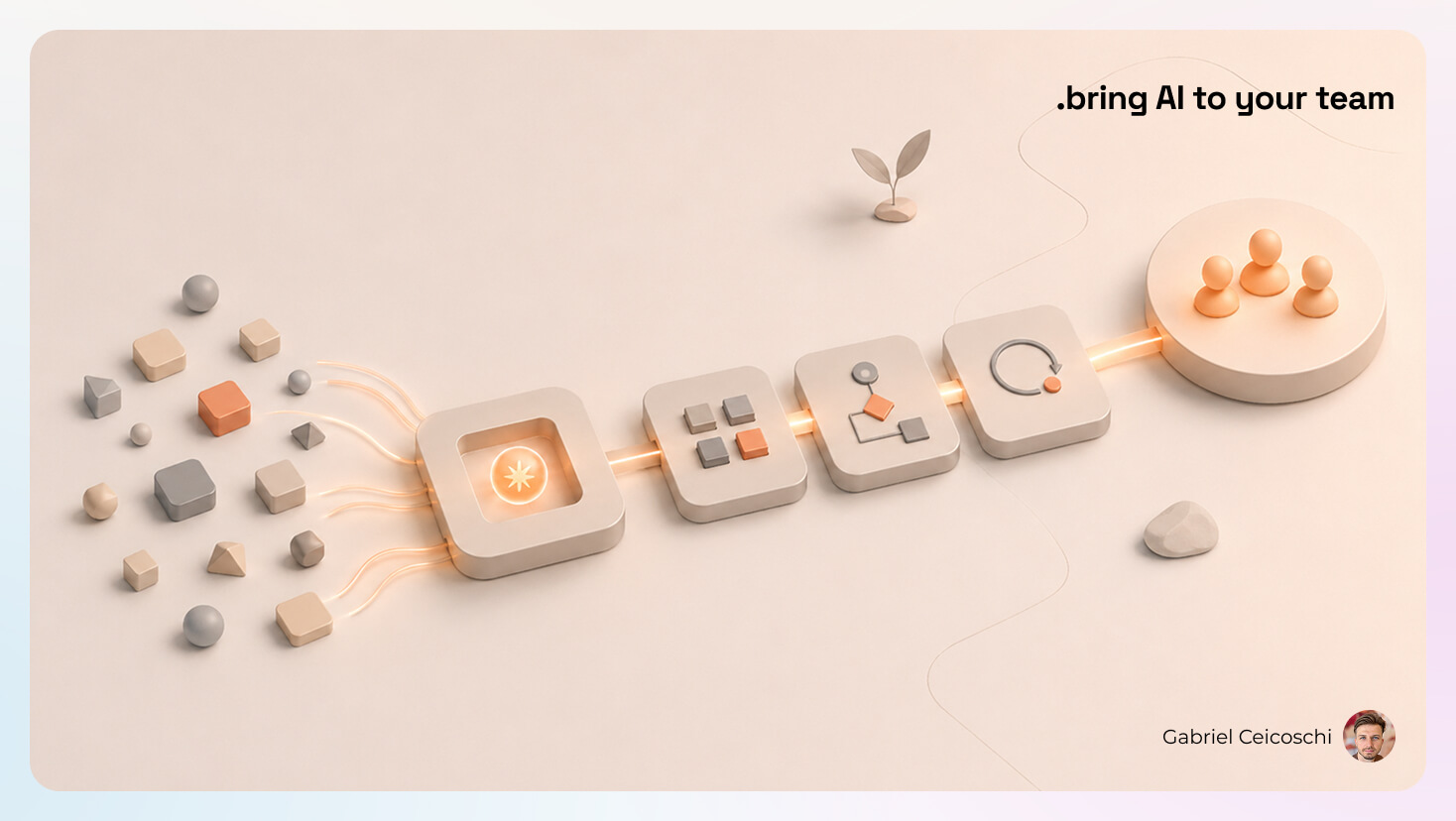
Most companies no longer have an AI access problem. They have a problem turning access into useful behavior.
Employees have ChatGPT, Claude, Copilot, or another AI tool. They have seen demos, attended workshops, and heard plenty about what AI is supposed to change. Yet inside the same company, you can often find completely different levels of adoption.
One employee has redesigned a meaningful part of their job around AI. Another uses it occasionally to rewrite an email. Someone else does not know where it belongs in their work. Another person tried it a few times, got disappointing results, and decided it was not particularly useful.
This is why asking how to get employees to "use more AI" is often the wrong starting point. The more useful question is how to help a team improve a real piece of work with AI.
That changes the focus from tool adoption to work improvement.
What does AI adoption actually look like inside a team
Companies often measure AI adoption as if employees fall into two groups: users and non-users.
In practice, the difference between opening ChatGPT and building repeatable AI-enabled workflows is enormous.
Someone at the beginning might have little practical experience and no clear idea where AI fits into their role. An occasional user may rely on it for rewriting, brainstorming, search, or summaries. A more experienced employee has repeatable tasks where AI consistently helps. Further along, someone begins combining AI with company knowledge, tools, automation, verification, and human judgment to redesign an entire workflow.
Not everyone needs to reach the most advanced level, but this progression matters because access alone does not create equal capability.
Two employees can have exactly the same AI license and radically different abilities to use it well.
Which employees should you focus on first
We have seen this clearly in recent client work. In one organization, the most interesting opportunity was not with complete beginners or the strongest AI users. It was the group in the middle: people who were already experimenting, understood enough to be curious, but still relied on ad hoc usage and help from more technical colleagues.
That group had enough confidence to change how they worked, but still had substantial room to improve the work itself. The beginners first needed basic fluency. The strongest users were already building and automating. The middle group had both a meaningful capability gap and enough practical experience to close it through real work.
This has become an important lesson for how we think about adoption programs. Company-wide training can still be useful, but the first transformation pilot does not always need to include everyone. A smaller cohort with enough curiosity, process ownership, and recurring knowledge work can often prove the method much faster.
How do employees actually become better at using AI
There is also growing evidence that people become more effective AI users through experience.
Anthropic's 2026 Economic Index research found that more experienced Claude users tended to bring more challenging and work-related tasks to the model and achieved higher conversation success rates. The analysis showed better outcomes among longer-tenure users, although Anthropic also notes that learning by doing is only one possible explanation.[1]
The broader pattern makes intuitive sense.
Effective AI use requires judgment. Employees gradually learn what kinds of work the model handles well, how much context it needs, how to structure a problem, when to iterate, what a suspicious answer looks like, what needs to be verified, and when AI should not be used at all.
That knowledge is difficult to transfer through a presentation alone.
People become better at using AI by applying it to work they understand, seeing what happens, and improving their approach.
Why does generic AI training often fall short
The standard company rollout usually starts with tools.
A company buys licenses, organizes training, teaches prompting, shows a few impressive examples, and sends employees back to their normal jobs. A few months later, leadership checks the adoption numbers and wonders why usage is uneven.
The problem is that almost everything about the employee's work remained the same. The same processes still exist. The same meetings happen. The same systems need to be updated. The same approvals are required. The same incentives remain in place.
The organization added a new tool without changing the environment in which the employee works.
Deloitte's 2026 State of AI in the Enterprise found that worker access to AI increased substantially during 2025, while insufficient skills remained one of the biggest obstacles to integrating AI into existing workflows. Organizations have responded heavily with education and upskilling, but deeper process and role redesign has moved more slowly.[2]
Training is useful. Employees need to understand the technology and its limitations.
But knowing what AI can theoretically do is different from knowing what you should do differently on Monday morning.
That second question is where adoption becomes practical.
Should you teach the outcome before the AI vocabulary
We learned this lesson directly in one of our earlier technical workshops. The fundamentals were useful, but the energy in the room changed once we showed a working system. A participant later told us that for a more experienced audience, we should have reversed the structure and started with the working outcome, then explained the components underneath it.
We took that feedback seriously.
It is much easier for people to care about context windows, tools, agents, automation, or verification once they can see what those concepts make possible in their own work. Without that connection, technical vocabulary becomes another thing to remember rather than something they need to solve a problem.
This is why we increasingly lead with the work and let the technology appear as the solution requires it.
Where should AI adoption start
One of the clearest lessons from our work with teams is that AI becomes easier to understand when there is a real problem attached to it.
Instead of starting a workshop with a list of features, begin with the employee's work.
Ask what takes too long, what they repeat every week, where they spend time gathering information, what they copy between systems, where they wait for someone else, what they draft repeatedly, what they review repeatedly, and where they wish they had more capacity.
Those questions immediately produce something more useful than "What could you do with ChatGPT?"
They produce a workflow.
Suppose a team chooses weekly reporting. Now the conversation is no longer about AI in the abstract. The team can examine what information should be collected automatically, what AI should analyze, which changes should be flagged, what can be drafted, where human judgment is necessary, how the result should be verified, and where the final output should go.
People are learning AI inside a process they already understand deeply.
That makes adoption much more concrete.
Why does learning improve when there is something real to build
In another large workshop, we deliberately spent less time teaching AI terminology and more time helping participants turn real problems into concrete solutions. The useful learning happened while people were working through their own ideas and deciding where their expertise mattered and where AI could fill the gap.
The technology still had to be learned, but the order changed. Instead of learning a catalogue of tools and then searching for something to do with them, participants started with a problem worth solving and learned the technology necessary to move it forward.
That experience reinforced one of the central principles behind how we approach AI adoption at Aibl.to: start with the problem worth solving, then learn the technology necessary to solve it.
Not the other way around.
Why is a blank AI chat not enough for most employees
One common mistake in AI adoption is to provide employees with a powerful model and tell them to experiment.
Some people thrive in that environment. They become the early power users and often discover valuable applications on their own.
Most employees are not paid to spend hours every week independently redesigning their roles. They already have deadlines, meetings, responsibilities, and existing systems to operate.
They may also be uncertain about what they are allowed to do. They may not know which information can be shared, which use cases are worth trying, what a good output should look like, how much they can trust the result, or who is responsible if something goes wrong.
A blank text box contains enormous capability, but very little guidance.
This is why shared workflow patterns are useful.
Instead of telling someone to "use AI for research," show a repeatable approach for gathering information, synthesizing it, verifying the important facts, drafting the output, and reviewing the result. Instead of telling a team to "automate intake," help them structure how a request is classified, enriched with context, routed, acted on, and escalated when necessary.
The employee no longer has to invent an AI operating model from scratch. They have something concrete they can test and improve.
What actually makes employees adopt AI
Employees generally do not care about maximizing an organization's AI adoption metric. They care about getting their work done.
This sounds obvious, but it has important implications for how adoption programs should be designed.
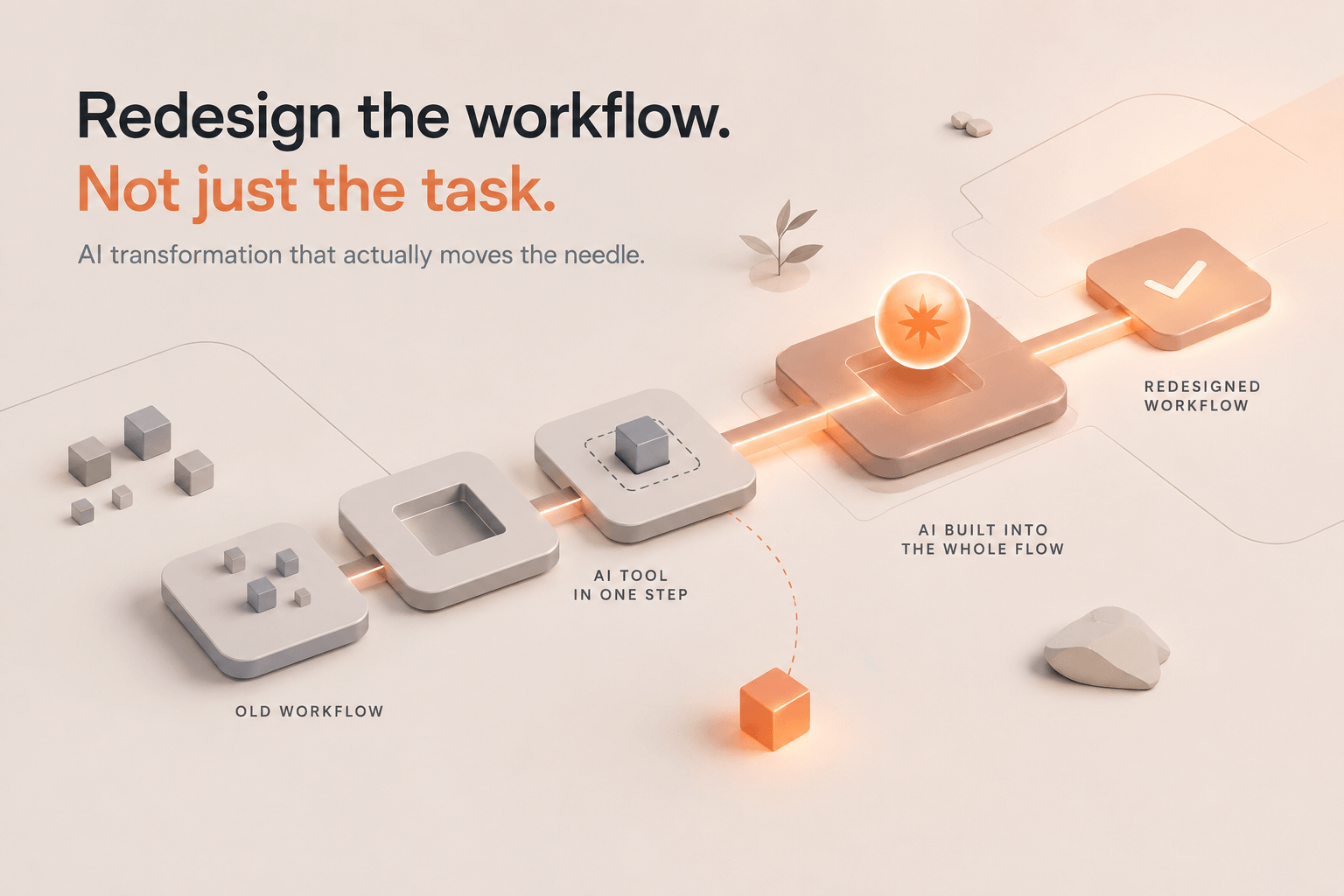
A goal such as "everyone should use AI three times per week" creates usage without necessarily creating value. A goal such as "each team should improve one recurring workflow" changes the incentive completely.
Now AI is attached to something employees already care about: removing repetitive work, finding information faster, reducing frustration, improving quality, responding more quickly, or creating more capacity.
People are much more likely to adopt a new way of working when they can see the improvement directly.
Does everyone need to become an AI expert
Another mistake is assuming that successful adoption requires every employee to understand AI at the same technical depth.
A lawyer does not need to become an AI engineer. An HR manager does not need to understand model architecture. A financial analyst does not need to know how to build autonomous agents.
Most knowledge workers do, however, need practical AI fluency.
They need to understand what AI is useful for in their own work, where it is unreliable, what context it requires, which outputs should be verified, what can be delegated safely, and what should remain under human control.
That kind of fluency is more valuable than memorizing terminology.
BCG's 2026 AI at Work research found that 72% of workers said AI had already changed the skills expected in their roles.[3]
That suggests the adoption challenge is not simply getting people to open an AI tool. It is helping them develop the judgment necessary to work differently because the tool exists.
How should you use AI power users without creating dependency
Most organizations quickly develop a small group of employees who are much more enthusiastic about AI than everyone else.
Those people are valuable. They can test new approaches, show colleagues what is possible, mentor less experienced users, and translate technical capabilities into practical use cases.
The risk is allowing all of the organization's AI knowledge to remain concentrated in that small group.
If one employee builds every workflow and is the only person who understands how those workflows operate, the organization has not created a scalable AI capability. It has created a new dependency.
The better progression is to turn individual experiments into repeatable workflows, document what worked, and make those patterns available to other employees.
This is how individual capability becomes organizational capability.
Is building everything together always the right approach
There is another practical lesson that becomes obvious once you start doing this inside real organizations: not every team has enough time to build every technical component itself.
A pure "build it together" model sounds ideal because it maximizes learning, but it can fail when employees are already operating at full capacity. In those situations, a hybrid approach can work better. The team stays deeply involved in workflow design, key decisions, testing, and ownership while someone else handles heavier implementation between sessions.
The goal is still capability transfer. The difference is that learning is designed around the organization's actual capacity rather than an idealized training model.
This matters because adoption is not successful when employees can explain how a workflow might work. It is successful when the workflow actually becomes part of daily work and the team can own it afterwards.
How do you turn AI adoption into a learning loop
A one-time training session ends. A useful adoption system keeps learning.
The cycle usually begins with real work. A team identifies something worth improving, tries a new approach, applies it inside the real workflow, measures the result, improves what did not work, and shares the pattern with others.
Then the process repeats.
Over time, the company develops its own library of working AI patterns based on its actual processes, data, tools, and expertise.
This is much more powerful than trying to predict every useful AI application centrally.
The organization learns what works by changing real work and observing the results.
How should you measure AI adoption
This also means the success of an AI adoption program should not be measured primarily by workshop attendance, licenses purchased, or prompts sent.
Those metrics can be useful operationally, but they do not tell you whether the organization has developed a meaningful capability.
A stronger measure is whether recurring workflows changed.
Did manual work disappear? Did cycle time improve? Did people create more capacity? Did the quality of the output improve? Are employees using AI in repeatable ways rather than occasionally? Can successful workflows be reused by other people? Are fewer employees dependent on a single power user for help?
Ultimately, the most important question is whether the way the team works is different.
If the answer is no, the company may have AI usage without meaningful adoption.
What do managers actually need to know about AI
Managers have an important role in this transition, but they do not need to become the most technically advanced AI users in the organization.
Their job is increasingly to recognize where work can change.
A useful exercise is to ask a team what part of their work they would redesign if they had an assistant capable of reading large amounts of information, writing quickly, analyzing context, searching across knowledge, and interacting with tools.
Then ask what they would still want a person to own.
Those two questions begin separating mechanical execution from judgment.
That is usually much more useful than another hour spent discussing prompting techniques.
What is the real goal of AI adoption
If an employee uses AI once a week to rewrite an email, that is technically adoption.
If they redesign a recurring process and remove several hours of manual work each week, something more meaningful has happened.
If the team then turns that process into a shared workflow that other people can use, the organization has started building a capability.
And if the company develops a repeatable way to discover, redesign, build, measure, and transfer these workflows, AI begins to disappear into the way the company operates.
People stop thinking, "Now I should go use AI."
It simply becomes how that piece of work is done.
The question is not how to make employees use more AI. The question is which piece of work should become meaningfully better because AI now exists.
Start there, and adoption becomes much easier to solve.
Frequently Asked Questions
How do you get employees to use AI at work?
Start with a real workflow or pain point employees already care about. Help them apply AI to that work, measure whether the result improves, and turn successful approaches into repeatable patterns the team can reuse.
Is AI training enough to drive adoption?
Usually not by itself. Training creates awareness and basic skills, but employees also need opportunities to apply those skills to real work, practice, receive guidance, and see useful results.
Should every employee become an AI expert?
No. Different roles require different levels of technical understanding. Most employees need practical AI fluency, including knowing where AI helps, what context it requires, what needs verification, and where human judgment remains necessary.
How should companies use AI power users?
Power users can experiment, mentor colleagues, and discover valuable workflows. The important next step is turning their best experiments into documented and transferable systems so the organization does not become dependent on a few individuals.
How should AI adoption be measured?
Look beyond licenses and active users. Measure whether employees use AI in repeatable workflows, whether processes change, whether manual work decreases, and whether quality, capacity, cycle time, or other business outcomes improve.
Why are employees not using the AI tools we bought?
Common reasons include unclear use cases, insufficient confidence, uncertainty about what is allowed, lack of workflow integration, weak guidance, and no strong reason to change an existing way of working. Providing access does not automatically change behavior.
Related articles
Show us how your team works.
Bring a process that wastes time or money. We will help you build an AI workflow around your data, tools and limitations.