AI Prompt Engineering for Teams: A Practical Workshop Framework That Works
September 5, 2025
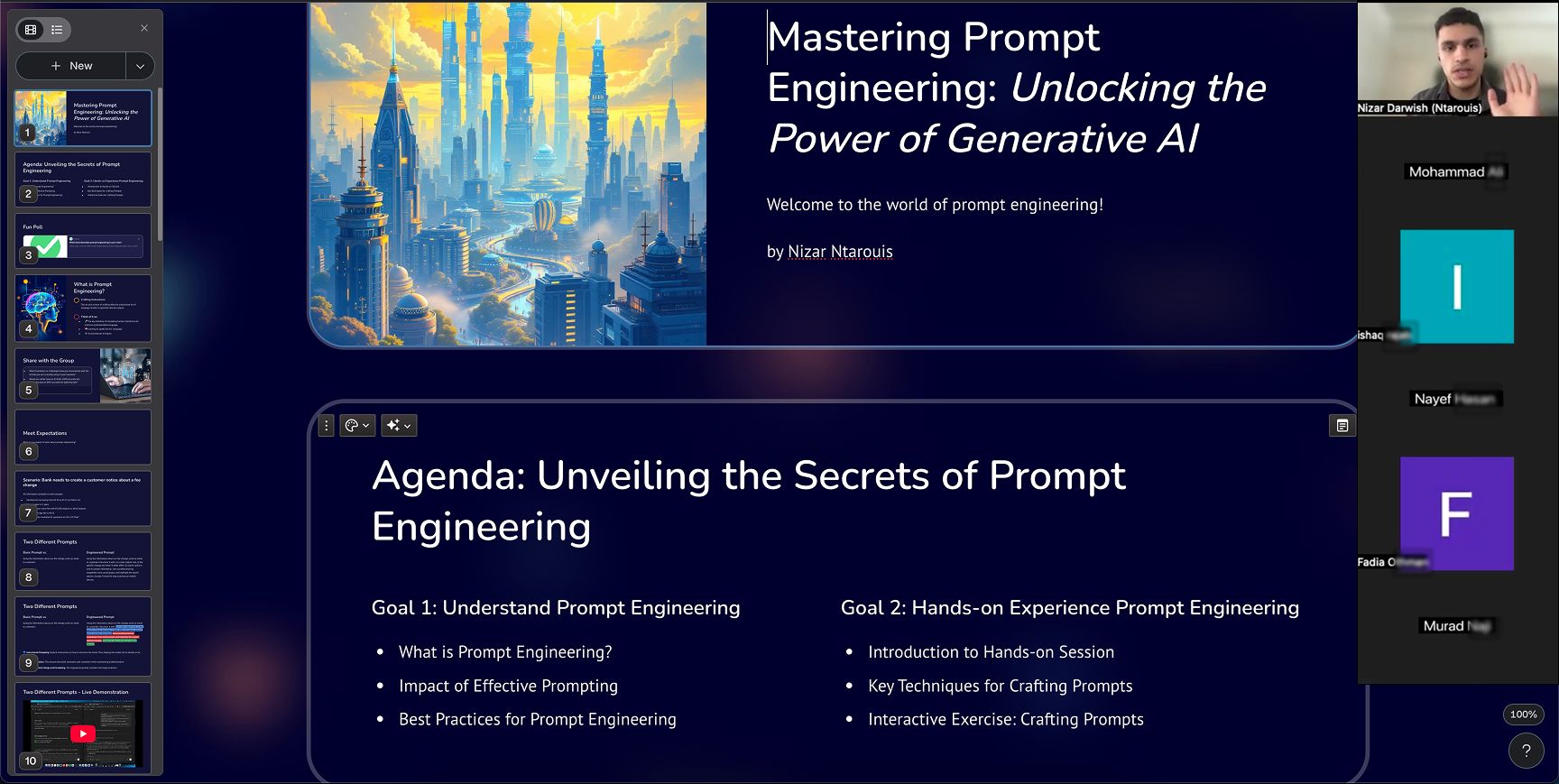
Last week, I walked into a room full of professionals, all staring at the same thing: a blank input box on their screen.
Silence. A few nervous laughs. Someone whispered, "Where do we even start?"
We had just begun our second session on AI Integration and Prompt Engineering. And in that moment, I realized the biggest barrier wasn't the technology-it was the blank page syndrome that every writer knows all too well.
The Breakthrough Moment
That's when everything shifted. Instead of diving into technical prompt engineering techniques, I asked the group to completely reframe their thinking:
"Imagine the AI not as something to be engineered, but as a brand-new intern on your team."
This intern is:
- Smart? Absolutely.
- Experienced? Not yet.
- Useful? Only once you guide it properly.
Just like any new team member, AI becomes truly valuable when you share your expertise, priorities, and context with it.
The Simple Framework That Changes Everything
We broke through the paralysis with a straightforward approach. Before writing any prompt, ask yourself:
1. What's Your Purpose?
- What specific outcome do you need?
- What problem are you trying to solve?
- What would success look like?
2. What Instructions Will Get You There?
- What steps would you tell a human colleague?
- What approach works best in your industry?
- What pitfalls should be avoided?
3. What Context Matters?
- What background information matters?
- What constraints exist?
- What standards must be met?
4. What Format Do You Want Back?
- Bullet points, paragraphs, or tables?
- Formal or conversational tone?
- How long should the response be?
The Transformation
Suddenly, the energy in the room shifted completely. Instead of blank stares, screens began filling with thoughtful, structured prompts. The AI stopped giving generic, one-size-fits-all answers and started producing insights that matched each participant's professional standards and industry requirements.
It wasn't magic-it was clarity.
What We Discovered Together
From there, the session came alive as we explored a few concepts:
Strong Instructions = Strong Outputs
We demonstrated how specific, context-rich prompts consistently outperformed vague requests. The difference between "help me write a report" and "help me write a quarterly sales report for pharmaceutical clients, focusing on Q3 performance metrics, written for executive leadership" was dramatic.
Industry-Specific Prompt Crafting
Participants worked in real-time to create prompts tailored to their specialized fields:
- Banking professionals developed compliance-aware prompts
- Healthcare workers created patient-privacy-conscious queries
- Academic researchers built citation-friendly research assistants
The AI Ladder Strategy
We mapped out how AI adoption grows:
- Individual experiments (where we were)
- Team pilots (next phase)
- Department integration (scaling up)
- Enterprise deployment (full transformation)
Business Strategy Alignment
Most importantly, we connected AI adoption directly to business objectives, showing how each prompt optimization contributes to larger organizational goals.
The Main Takeaway
By the end of the session, participants had grasped the most important lesson: every prompt is a mini-training moment. Each interaction passes a little bit of your expertise into the system, gradually turning your "AI intern" into a knowledgeable co-worker you can rely on.
The Efficiency Question
Of course, some sharp participants quickly identified a real limitation:
"Do we really need to copy and paste the same prompt every time just to get consistent results?"
This question perfectly illustrates the natural progression of AI literacy. Once people master the fundamentals of prompt engineering, they immediately recognize the need for the next level: automation and integration.
What Comes Next
That efficiency question becomes the perfect bridge to our next workshop focus: teaching AI systems to remember your preferences, automate repetitive prompting, and integrate seamlessly into existing workflows.
The goal isn't just better prompts-it's creating AI systems that stop requiring constant instruction and start running parts of your workflow independently.
The Bigger Picture
The story of AI in business isn't really about technology. It's about people learning how to teach these systems and shaping the tools to fit their work.
That blank screen moment? It's not a barrier. It's where the conversation starts.
Frequently Asked Questions About Prompt Engineering
What is prompt engineering?
Prompt engineering is the practice of crafting clear, structured instructions for AI tools like ChatGPT, Claude, or Gemini to get consistent, high-quality results. It's not about "tricking" the AI - it's about communicating effectively, just like you would train a new team member.
How do I write better AI prompts?
Use the 4-part framework: (1) State your Purpose - what outcome you need, (2) Give clear Instructions - steps a human colleague would follow, (3) Provide relevant Context - background information and constraints, (4) Specify the Format - how you want the response structured (bullets, paragraphs, tables, tone, length).
What's the difference between zero-shot and few-shot prompting?
Zero-shot prompting gives instructions without examples: "Write a professional email declining a meeting." Few-shot prompting includes 1-3 examples: "Write a professional email like these examples: [example 1], [example 2]." Use few-shot when you need the AI to match a specific style or format.
Do I need a technical background to learn prompt engineering?
No. Prompt engineering is about clear communication, not coding. If you can explain a task to a human colleague, you can learn prompt engineering. Our workshop participants include marketers, HR professionals, sales teams, and managers - no technical background required.
Why do my ChatGPT prompts give generic responses?
Generic prompts get generic responses. Instead of "help me write a report," try: "help me write a quarterly sales report for pharmaceutical clients in Northern Europe, focusing on Q3 2025 vs Q3 2024 performance, written for executive leadership in formal tone, 500 words max." The more specific your prompt, the better the output.
How long does it take to learn prompt engineering?
You can learn the basics in 3 hours with hands-on practice. Our workshop participants go from prompt paralysis to confident practitioners in a single session. Mastery comes with practice - applying the framework to your specific work over 2-4 weeks.
Can I use the same prompts for ChatGPT and Claude?
Yes, the 4-part framework works across all major AI tools (ChatGPT, Claude, Gemini, Copilot). You may need minor adjustments - Claude prefers more context and responds well to role-based prompts, while ChatGPT is faster with concise instructions - but the core structure remains the same.
Ready to transform your team's relationship with AI? Join our hands-on workshops and learn this exact framework, from prompt paralysis to AI mastery in 3 hours.
One call. We'll show you exactly what we'd build with your team.
No pitch decks. No generic proposals. Just a conversation about your workflows and what we can automate together.